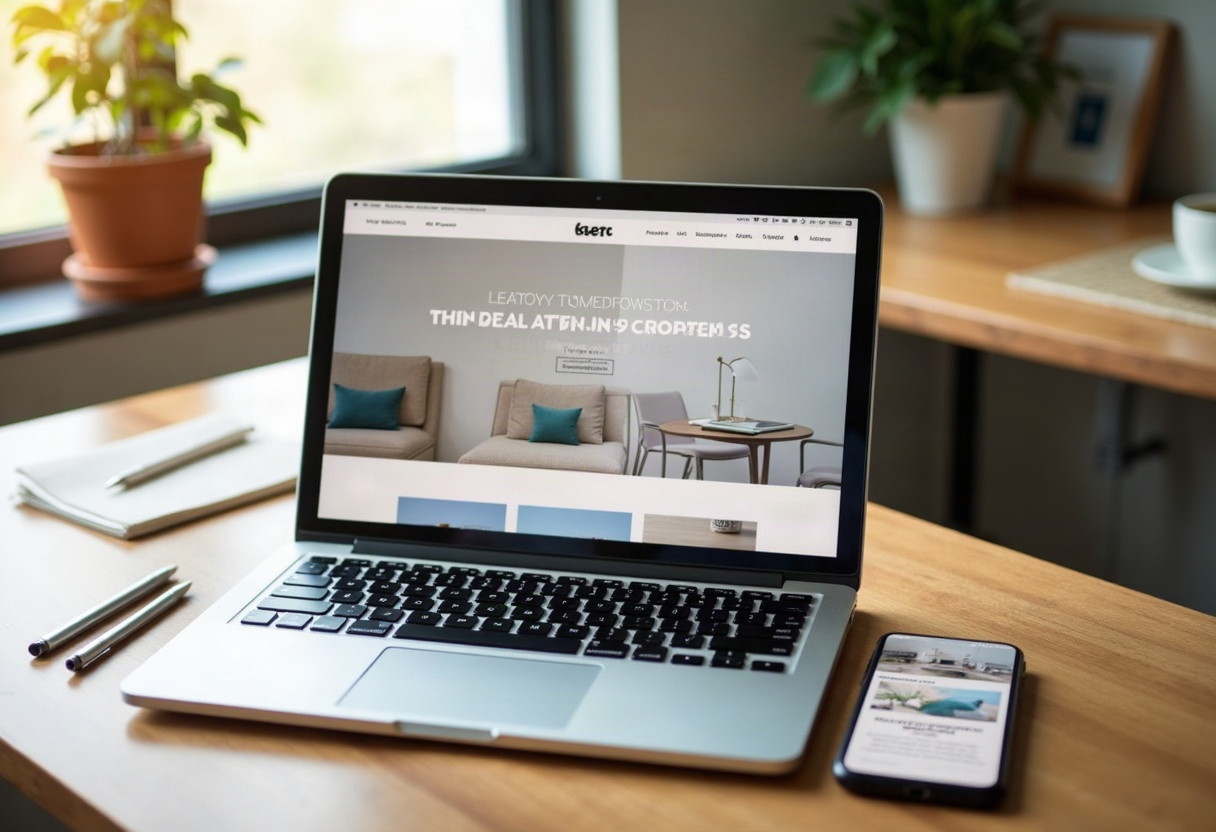
Your website is not a brochure. It is the first interaction most potential customers will have with your business, and it happens in the time it takes someone to glance at their phone. For a Kent plumber, a Renton electrician, or a Tacoma restaurant, that interaction starts before anyone reads a word of copy. It starts with design.
The 50-Millisecond Judgment
Research from the Stanford Persuasive Technology Lab found that people form an opinion about a website's visual appeal in 50 milliseconds — roughly the time it takes a hummingbird to flap its wings once. That opinion determines whether a visitor stays or leaves. A dated layout, mismatched fonts, or a logo that looks like it was made in 2009 signals that the business behind the site is equally outdated.
This matters more for local businesses than for national brands. A national brand can overcome a mediocre website with advertising spend. A Kent roofing company competing with 15 other roofers cannot — the prospect will simply tap the next result in Google Maps.
Core Web Vitals: Design Decisions That Google Measures
Google's Core Web Vitals are not abstract metrics. They are direct outputs of design and development choices:
- Largest Contentful Paint (LCP) measures how fast the main content appears. A hero image that is 3 MB because nobody compressed it adds 2 seconds to LCP. That is a design decision — choosing to serve an optimized image or not.
- Cumulative Layout Shift (CLS) measures visual stability. If a banner ad or a late-loading font pushes the page content down after the user starts reading, CLS spikes. Choosing system fonts over custom web fonts, or preloading critical resources, eliminates this.
- Interaction to Next Paint (INP) replaced First Input Delay in 2024. It measures how quickly the page responds when a user taps a button or fills a form. Heavy JavaScript frameworks that render everything client-side tank INP. Server-side rendering and minimal client JS fix it.
A website that fails Core Web Vitals ranks lower in Google. Not because Google punishes ugly sites, but because slow, janky, unresponsive pages are a worse experience for the user — and Google's algorithm knows it.
If your site is built on a platform that ignores these metrics, read our custom website design guide for Kent businesses to understand what a performance-first approach looks like.
Mobile Is Not a Variant — It Is the Default
Over 60% of local search queries happen on mobile devices. Someone searching "plumber near me" on their phone in Auburn is not going to pinch-and-zoom to read your desktop layout. If your site is not designed mobile-first — with tap targets large enough for fingers, text large enough to read without zooming, and a layout that reflows naturally — you are losing more than half your potential customers before they reach your phone number.
Mobile design is not about making the desktop site smaller. It is about rethinking the experience for a smaller screen, a touch interface, and a user who is probably standing somewhere looking for immediate help. The call button should be visible without scrolling. The address should be tappable to open Maps. The hours should be obvious.
Conversion: Design That Turns Visitors Into Phone Calls
A website that looks beautiful but does not generate phone calls is an expensive art project. Conversion is a design function. Every element on the page either helps or hurts the path from "I found your site" to "I called your number."
A clear call-to-action button above the fold, a phone number in the header that is clickable on mobile, a contact form with three fields instead of twelve — these are design choices that directly affect revenue. A site that hides its contact information behind a menu, uses a dark-on-dark color scheme that fails contrast checks, or buries the phone number in the footer is designed to lose customers.
For local businesses in the Puget Sound, the goal is simple: when someone lands on your site, they should know what you do, where you are, and how to reach you within 10 seconds. If your current site cannot pass that test, you are losing leads.
Accessibility Is Not Optional
The Americans with Disabilities Act applies to websites. In 2025, courts ruled that businesses must ensure their websites are usable by people with disabilities. This means:
- Color contrast ratios of at least 4.5:1 for body text
- Alt text on every image
- Keyboard navigation for users who cannot use a mouse
- Screen reader compatibility for all interactive elements
An accessible site is not just legally safer. It is a better site for everyone. Captions on videos help users in noisy environments. Alt text helps your image SEO. Keyboard navigation helps power users. Accessibility and good design are the same thing.
The Real Cost of a Bad Website
Let us put numbers on it. Say your Kent business gets 500 website visitors per month from local search. Your current site converts 1% of them into leads — 5 calls or form submissions. A well-designed site with a clear call to action, fast load times, and mobile optimization might convert 3% — 15 leads from the same traffic.
At an average customer value of $500, the difference is $5,000 per month in lost revenue. Over a year, that is $60,000 — the cost of not investing in a professional website.
Now factor in the SEO penalty. A slow site ranks lower, which means fewer visitors, which means even fewer leads. The compound effect of a bad website is not linear — it accelerates. The longer you wait, the further behind you fall, and the harder it becomes to catch up.
If you are wondering how to find the right developer to fix this, our guide on choosing a web developer in Kent walks through the questions to ask before hiring anyone.
What Good Web Design Looks Like in 2026
A good local business website in 2026 has these characteristics:
- Loads in under 2 seconds on mobile — measured by LCP, not gut feeling
- Single clear call to action above the fold — phone number, contact form, or booking button
- Schema markup for LocalBusiness — so Google understands your business name, address, phone, and service area
- Mobile-first responsive design — not a desktop site squeezed onto a phone
- Accessible color contrast and navigation — for legal compliance and user experience
- Internal linking structure — connecting service pages, blog posts, and the homepage so Google can crawl everything
- Clean heading hierarchy — one H1 per page, logical H2 and H3 structure
- Optimized images — WebP format, lazy loading, descriptive alt text
None of these are optional. A site that checks 6 out of 8 is still losing leads from the 2 it misses.
Why Local Businesses in Kent Need This More Than Most
Kent, WA sits in one of the most competitive local search markets in the Pacific Northwest. You are competing with businesses in Renton, Auburn, Tukwila, and Seattle for the same pool of customers. The businesses that win are the ones whose websites load fastest, answer questions clearest, and make it easiest to call.
A website is not a one-time expense. It is an asset that either generates revenue or loses it every day. If yours is losing, the fix is not more advertising — it is better design. And if your SEO foundation needs work alongside your design, our local SEO services for Kent small businesses can help you build a site that ranks and converts.
Ready for a site that ranks and converts? See our web design services or contact Digital Project LLC to start the conversation. To see what a full professional SEO service covers, read what does a professional SEO service include.
The question is not whether you can afford a professional website. The question is whether you can afford to keep losing the customers your current one is turning away.